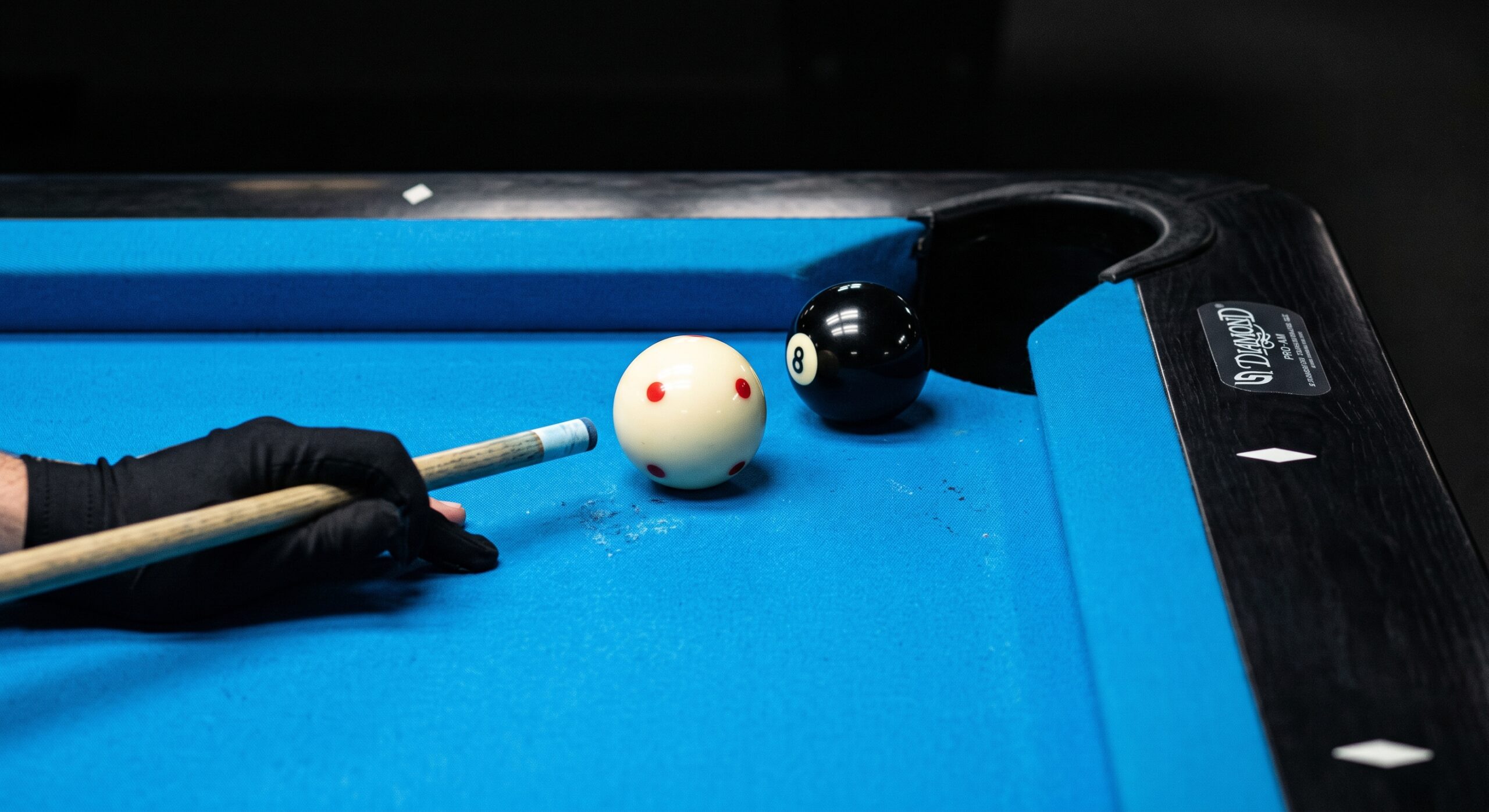
In competitive 8-ball governed by CSI (CueSports International), BCA (Billiard Congress of America), and WPA (World Pool-Billiard Association) standards, an obvious shot is defined as an attempt where the target object ball and its target pocket are unmistakable to both the shooter and the opponent, eliminating the need for verbal nomination or physical gesturing. Conversely, slop refers to any uncalled pocketing occurrence—whether an object ball falls into an unintended pocket, caroms unexpectedly off secondary obstacles into a pocket, or enters a hole after an unnominated bank or kick trajectory. Under standardized call-shot rules, slop confers no offensive advantage: an uncalled ball made in error or via erratic deflection yields an immediate loss of inning, with the incoming shooter taking the table in position.Clinical Definition (CSI/BCA Rule 1.16): An obvious shot requires no verbal designation. However, if the opponent has any doubt regarding the intended ball or pocket, they must verbally challenge the shooter prior to the execution of the shot. If an uncalled, non-obvious shot drops, no foul is assessed, but the shooter’s inning terminates immediately and all pocketed balls remain down.
Non-Obvious Trajectories: Shots Requiring Mandatory Verbal Nomination
Under CSI/WPA Rule 1.16 (“Calling Shots”), five specific collision classes and mechanical pathways deviate from standard linear sightlines and are categorized as non-obvious by definition. For each of these categories, the shooter must verbally nominate the specific object ball and intended pocket prior to addressing the cue ball:
- Bank Shots (Banks): Any shot where the intended object ball contacts one or more cushions prior to entering the pocket. The shooter is not required to specify the number of cushions contacted or rail-first incidental kisses, but the ball identifier and final pocket coordinate must be declared explicitly (e.g., “11-ball in the side”).
- Kick Shots (Kicks): Any shot where the cue ball contacts one or more cushions before impacting the designated legal object ball. While the object ball’s trajectory into the pocket may appear direct, the pre-contact rail rebound classifies the shot as non-obvious.
- Combination Shots (Combinations): Any sequence where the cue ball impacts a legal target ball, which then transmits kinetic energy through one or more intermediate balls to drive the terminal ball into a pocket. The shooter must name the final pocketed ball and the pocket; intermediate colliding balls do not need to be recited.
- Carom Shots (Caroms): Any shot where the cue ball glances off a primary object ball and subsequently propels a secondary target ball into a pocket. The carom redirection removes the shot from the obvious category, mandating verbal designation.
- Carom Combinations (Multi-Collision Clusters): Complex collisions involving both cue ball carom deflection and secondary object-ball billiard transfer. Given the severe kinetic chaos of cluster separations, verbal nomination is required to prevent disputes regarding intentionality versus fluked trajectories.
Key Diagnostic: Incidental kisses, caroms off balls after the primary collision, or rail contacts do not invalidate an otherwise obvious shot if the object ball tracks directly to the intended pocket through intended kinetic transfer. However, if a collision fundamentally alters the pocket designation, the absence of an advance call forfeits the inning.
Calling Shots: APA vs. BCA/CSI vs. House Bar Rules
Governing bodies treat slop and shot nomination with fundamentally divergent philosophies. The comparative matrix below outlines the mechanics of each system:
| System | Slop Permitted? | Obvious Shot Criteria | Call Ball AND Pocket Required? | Unintended Pocket Outcome |
|---|---|---|---|---|
| APA (American Poolplayers Association) | Yes (Except 8-Ball) | None. All balls pocketed on a legal stroke count during open play, regardless of path or intent. | No on standard balls; Yes on 8-ball (shooter must mark pocket physically). | Standard balls: Inning continues, points credited. 8-ball: Loss of game. |
| BCA / CSI (World Standardized) | No | Natural straight-in or simple cut shots with unambiguous trajectory and single target pocket. | Yes, on all non-obvious shots (banks, kicks, combos, caroms). Ball and pocket only. | Inning ends; pocketed balls stay down; no foul (incoming player accepts table as it lies). |
| House / Bar Rules (Tavern Arbitrary) | Varies / Volatile | Unstandardized. Often relies on ambiguous phrases like “clean roll” or “no incidental slop.” | Often mandates calling every rail, kiss, and deflection, causing frequent arguments. | Inconsistent: Arbitrarily penalized with ball-in-hand, illegal re-spots, or loss of turn. |
Pre-Stroke Communication Protocols: Preventing Table Disputes
Table conflict invariably stems from silent assumptions made prior to the backswing. To preserve competitive integrity and adhere to CSI/BCA tournament guidelines, players should implement the following pre-shot communication workflow:
1. The Pre-Shot Inquiry Rule
The burden of clarity is reciprocal:
- Shooter Responsibility: If executing a bank, kick, combination, or tight cut into a blind angle, verbally nominate the ball and pocket before taking your stance (e.g., “7-ball in the corner”).
- Opponent Obligation: Under CSI regulations, if the opponent cannot decipher the shooter’s intent, the opponent must ask, “What are you shooting?” prior to the player settling into their shooting posture. Waiting for the outcome of the stroke to dispute an uncalled shot is an invalid tactical delay.
2. The Physical and Verbal Designation Standard
Avoid vague non-verbal cues. In crowded or high-decibel tournament rooms:
- State the ball number and target pocket clearly: “9-ball in the right side.”
- Supplement verbal designation with an unambiguous physical cue point directly at the intended pocket.
- Do not point vaguely at clusters; identify the precise sphere if balls of identical group (solids or stripes) are bunched together.
3. Procedure for Unintended Pocket Drops
When an uncalled ball drops via an unintended trajectory:
- The shooter must step away from the table immediately without attempting a secondary follow-up stroke.
- The pocketed ball remains submerged in the pocket; it is never re-spotted in standard 8-ball (unlike 14.1 Continuous or specific rotation variants).
- No ball-in-hand is awarded unless an independent physical foul occurred (e.g., cue ball scratch, illegal contact, or failure to drive a ball to a rail).
- The incoming player addresses the table exactly as it lies.